

A Real-World Note
Krypton has been portrayed in several ways over the decades. Personally, I really like Kevin J. Anderson’s portrayal of Krypton in his book, The Last Days of Krypton, which attempted to incorporate many of the different depictions into one comprehensive image of the planet — and we are dealing with a whole planet here. There’s plenty of room to have wildly varying regions.
When it comes to Kryptonian culture, technology, and imagery, we’ve had so many cooks in the kitchen at this point that it’s likely impossible to reconcile everything into anything totally cohesive. Just focusing on media that has specifically portrayed Krypton and Kryptonian culture, people, science, etc., the list is startling large — especially considering how dramatically different most of these depictions are.
- Film: Superman (1978)
- Comics: World of Krypton (1979, Pre-Crisis)
- Comics: World of Krypton (1987, Post-Crisis)
- TV: Superman: The Animated Series (1996-2000)
- TV: Smallville (2001-2011)
- Book: The Last Days of Krypton (2007)
- Comics: The New Krypton Saga (2008-2010)
- Film: Superman/Batman: Apocalypse (2009)
- Film: Man of Steel (2013)
- TV: Supergirl (2015-2021)
- TV: Krypton (2018-2019)
- TV: Superman and Lois (2021-2024)
- TV: My Adventures with Superman (2023-present)
- Film: Superman (2025)
- Film: Supergirl (2026)
…and this doesn’t even account for the myriads of occasional glimpses of Krypton across long-standing comic series like Superman, Action Comics, Supergirl, and the like across Superman’s nearly 90 years.
Since so much of the Superman mythos is so garbled, so up in the air (pun intended), I am forced to do now what anyone seeking to portray Krypton must: pick and choose from the mythology in order to build something that is consistent and thorough. I am also taking some liberties to “fill in the blanks” so to speak — add some bits of cultural flavor that was been otherwise unexplored.
That’s what this page is.
I will point out that this might not be completely necessary when it comes to creating a language, but knowing the psychology and the culture of the people who speak your language is critically vital to informing linguistic decisions. Besides, for me, this little bit of world building, making something that doesn’t just touch upon the language, but sings with it — even if it only exists on this page — is every bit as fun as creating the language itself… they’re really two sides to the same coin.
Sources
The idea of 11 Kryptonian virtues was birthed from Kevin J Anderson’s wonderful book, The Last Days of Krypton. In the book, Anderson writes about 12 obelisks that Lara Lor-Van was going to use for an art project to “demonstrate the powerful foundations of Krypton’s civilization: Hope, Imagination, Peace, Truth, Justice, and others.” I think the intent in the book was likely that these were more Lara’s interpretation/representation of Kryptonian morals rather than an actual codified list of cultural platitudes. Combining that notion with the golden-age flag (which has 11 elements, the planet + 10 rays), I expanded Anderson’s list of 5 “and others” out to a full eleven, gave the list a name, and assigned them each a place on the flag which also indicated a reciprocity/synergy between specific pairs of virtues.
Extra special thanks to Tony Carey of Australia who worked closely with me to refine and codify the list to the 11 here and determine flag placement and pairings.
The Linguistic History of Modern Kryptonian
I pretended to be a researcher/analyst who had received cultural and linguistic data dumps directly from Superman’s Kryptonian archives. I presented all my “findings” and “research” (with an in-world voice/pespective) to Claude AI with some lengthy and detailed conversations. Then I let it do the entire write-up below — with some heavy-handed editorial oversight. Is this cheating? Yes. 😅
Historical Background: The Final War and the Planetary Federation
The language now known as Modern Kryptonian — or simply “Kryptonian” in most contemporary usage — is, quite unusually, a constructed language. It did not evolve organically as a natural language, and this historical context reveals much about some of its more unique features.
In the period preceding the formation of the Planetary Federation, Krypton endured what its own records refer to as the “Final War” — a prolonged era of catastrophic global conflict whose duration and brutality left deep scars on the collective Kryptonian psyche. The factions that emerged from this period were not merely geographical but ancestral and hereditary: the so-called “Houses,” which would go on to define Kryptonian social organization for the remainder of the planet’s history.
Among the first acts of the fledgling Science Council emerging from the ashes of war-torn Krypton was the appointment of a language committee, headed by the linguist Val-Zho, charged with creating a single unifying language for the fledgling government. This was one of several sweeping cultural initiatives enacted in parallel — the Planetary Flag, the formal codification of the Girod (discussed at length below) — all designed to foster planet-wide cohesion. The pace and breadth of the new language’s subsequent adoption surprised even its architects, though in retrospect the reasons are not difficult to reconstruct.
The Name “Krypton”
The planet’s name predates Val-Zho’s language, but it is a composite word in Modern Kryptonian: /kryp/, the first person plural pronoun, combined with /tahn/, “land” — yielding, roughly, “our land” or “we place.” This was almost certainly not an accident. Whether Val-Zho deliberately selected a pre-existing word that happened to carry this meaning in his new language, or whether he shaped the language so the planet’s own name would become meaningful within it, the result is the same: every time a Kryptonian speaks the name of their world, they are saying we belong here together. The founding virtue of the Federation — /zehdh/, Unity/Belonging — encoded in the toponym itself (more on that below).
The word also preserves important grammatical evidence. In Modern Kryptonian, alienable possession is marked through a fusion of pronoun and definite article into a unified possessive pronoun form. “Krypton” does not follow this system and possibly hints at an older and simpler construction of possessives.
The Girod: The Eleven Virtues
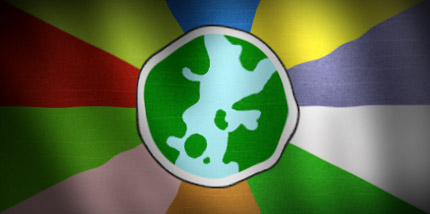
Central to any understanding of Kryptonian culture — and to the Federation’s remarkable success in unifying a war-torn planet — is the Girod: the eleven virtues that form the moral and civic backbone of Kryptonian civilization.
The Girod are not a civic invention. They are better understood as a consolidation — a recognition that principles already present, in varying distributions, across Kryptonian cultures were in fact a shared inheritance. The Federation’s committee did not create the Girod; it named, ordered, and canonized what was already there. The closest human analogues might be the classical cardinal virtues or the Beatitudes.
Every Kryptonian child learns the Girod at an early age. They are expected, more or less, to exemplify these virtues in their work. As adults, Kryptonians hold the Girod in high esteem and seek to reflect them in their lives. Below, each virtue is presented in the pedagogical order in which they appear on the flag, with notes on cultural significance.
The Flag and Its Structure

/zehdh/
Unity/Belonging
The designers of the Kryptonian flag took this virtue — historically reserved for one’s own House — and applied it to the entire planet, symbolizing that all Kryptonians belong to one family and share one home. It was given primary importance with the understanding that a successful and peaceful government requires that its populace have a genuine sense of belonging and ownership. It is represented by the image of the planet Krypton itself at the center of the flag.

/shokh/
Truth
Considered the primary virtue before the foundation of the Planetary Federation, Truth was given a place of primary importance on the new flag. This virtue encompasses not only honesty in dealings with one another, but equally the pursuit of knowledge — finding the truth of how things are and how they work. Though central to the science-based government that established the Federation, in the last days of Krypton, Truth gave way to fear and a kind of societal self-delusion — one of the more poignant ironies of Kryptonian history.

/urvish/
Peace
This virtue was placed at the top of the flag to symbolize peace above all — an aspiration that, near the end of Krypton’s history, was sometimes taken to counterproductive extremes. The color of the oceans was chosen as an object lesson: peace leads to beauty and prosperity, while “storms” lead to danger and calamity.

/uchahvia/
Synergy
The uniting of resources and purposes that leads to a strength greater than the sum of its parts. Yellow was selected as its color, a pre-existing symbol of power derived from the ancient discovery of the effect that Krypton’s yellow sun had on Kryptonian physiology — though this had become a little-known and closely-guarded secret by the time of the Federation’s formation.

/zhguzhor/
Imagination
Though usually rendered in solid purple, especially in conservative contexts, the color of this ray on the flag can officially be anything — iridescent, patterned, or pictorial — a direct reflection of the virtue it represents. Historically one of Krypton’s greatest cultural strengths, and the virtue with arguably the greatest potential to have saved the planet, Imagination was heavily suppressed in Krypton’s final years.

/ighai/
Purity
White was prominent in Council garb and government buildings, representing not only moral purity but also, across all areas of life, focus, single-mindedness of purpose, and resistance to distraction. As white light is composed of all colors, so purity encompasses all virtues. As white material — ice, crystals, paper — is free from blemish, so one must keep one’s life free from anything that would “stain.”

/tahrao/
Justice
Kryptonians tend toward a fair and balanced sense of justice, though it also tends to be swift — sometimes too swift — and heavy-handed in sentencing. One of the three core virtues (see below).

/:jahghah/
Restraint
It is in exercising this virtue that Kryptonians can, at times, appear cold or emotionless — a surface impression that belies a deeply passionate people who long ago learned that passion without restraint leads to catastrophe. The color orange was chosen to represent the balance of internal forces (desire, passion, self-interest — yellow) checked by external ones (morality, community — red).

/shahrrehth/
Hope
Translatable also as “optimism” — a sometimes stubborn belief that things can and will improve, and that one can be part of the solution. The pink of this virtue combines the white of Purity with the red of Rao, the Kryptonian sun and religious symbol.

/gazrhyg/
Industriousness
Considered one of the three core virtues, on the grounds that without action, diligence, and hard work, no other virtue can produce results. One of the three core virtues (see below).

/urkynon/
Altruism
Represented by red — the color of Rao, the Kryptonian sun, which is also the religious symbol of the power greater than the self, of community and selflessness. Rao as the “great gift-giver” makes red the natural color for generosity and altruism.

The Three Core Virtues
Green — the approximate center of the visible spectrum — was chosen to represent the centrality and importance of the three virtues considered foundational to Kryptonian civilization:
- Truth — Soh /shokh/ — bright green, symbolizing the light that truth sheds on any topic or situation.
- Industriousness — gaZRyg /gazrhyg/ — mid-green, connected to agriculture and growth — a large part of Krypton’s economy was built around farming, including the cultivation of sylten /syltehn/, an edible seaweed-like plant — symbolizing the prosperity that comes from hard work.
- Justice — täO /tahrao/ — the darkest green, representing the solid and weighty nature of Kryptonian justice.

The Three Civic Virtues
The newly-formed Planetary Federation acknowledged the pre-existing core virtues while choosing to emphasize a new triad for the Federation era. These proved to be the keys to what Kryptonian historians regard as their golden age.
- Truth — Soh /shokh/ — a push towards scientific and spiritual enlightenment
- Peace — üviS /urvish/ — the end of centuries of conflict
- Synergy — ucavÁ /uchahvia/ — great accomplishments made possible by planetary cooperation
The Virtue Pairings
Every virtue on the flag is arranged opposite another — with the exception of zeD, represented by the planet itself at the center. These pairings represent not balance or opposition but, characteristically, synergy: each virtue amplifies the other.

Truth & Justice
The more truth one has, the better and fairer justice will be. The more justice and civil discipline exist, the more they free a people for scientific, artistic, and spiritual pursuits of truth.

Peace & Restraint
One cannot have peace without restraint; the greater the self-control, the greater the peace. Restraint, in turn, is enabled by an inner peace — whether in an individual or a whole society.

Synergy & Hope
Through the combination of resources and abilities, the best possible outcomes can be reached, providing a solid foundation for hope and optimism. And one must have hope and optimism in order to place enough trust in others to cooperate and combine resources in the first place.

Imagination & Industriousness
Imagination provides ideas, direction, vision, and dreams. Hard work sees those things to fruition. Work and industry, likewise, naturally generate new ideas and innovations — as the old Earth proverb goes, necessity is the mother of invention.

Purity & Altruism
Purity in all areas of life naturally leads to a balance of self and other, from which altruism flows. Conversely, increasing generosity and outward focus quiets the internal distractions that undermine personal purity of morals, focus, and purpose.
The Rise and Fall of Krypton
In their selections, the Federation did elevate one value above the rest, /zehdh/ (Unity/Belonging), placing it first in the pedagogical sequence every schoolchild would learn. /zehdh/ already existed as a deeply felt virtue across Kryptonian cultures, and it was, in fact, one of the primary drivers of the tribalism that had ravaged the planet for generations. Loyalty, duty, in-group solidarity: these are the face of /zehdh/ as it was understood within House structures.
The Science Council’s genius was to take this deeply rooted engine of behavior and motivation and redraw the boundaries of the perceived “us” versus “them.” On a planet exhausted by centuries of war, telling people that they all belonged together as one greater “House” was an easy sell. It proved to be the release valve the planet needed. The radical unity of the Federation’s early years — a genuine planetary solidarity — rocketed Krypton into its millennia-spanning golden age and to the stars — proving, perhaps, another of the Girod’s virtues, synergy.
Of course, this overwhelming solidarity faded a bit after the initial honeymoon period, but Krypton never returned to the outright violent tribalism of the pre-Federation era. The virtue of restraint taking deep root. Arguments and ancient rivalries did resurface in a way. At first centered around House divisions, but more prominently between the guilds as they rose to prominence within Kryptonian societal organization. Although the Houses remained prominent in the Kryptonian cultural landscape, it was the guilds that grew into something more closely resembling a social caste system and the main driver of societal tensions. It seems that Krypton did manage to purge its violent tendencies.
The House System
Kryptonian society is organized around hereditary Houses — the institutionalized descendants of the factions that survived the Final War. These are not merely geographical groupings but ancestral ones, defined by bloodline and transmitted patrilineally. Sons carry the House name; women take their father’s House name and retain it for life regardless of marriage. The House of El, to take the most familiar example, produced Jor-El and his son Kal-El; Jor-El’s brother Zor-El was father to Kara Zor-El.
This naming convention exists in some tension with the language’s egalitarian gender-neutral defaults — a tension worth examining rather than resolving too quickly. It likely reflects a principled Kryptonian distinction between role (where gender is treated as irrelevant) and lineage (where patrilineal descent is the organizing principle). Whether this constitutes philosophical coherence or cultural contradiction is a matter of ongoing interpretive debate.
The Guild System
As Krypton stabilized and entered its golden age, a second organizational layer emerged alongside the Houses: the Guilds. Where Houses were organized around heredity and ancestry, Guilds were organized around vocation and skill. Each Guild functioned as something between a trade school, a university, a social club, a labor union, and a caste — meritocratic in admission, but all-encompassing in identity. The soldier’s guild, the agricultural guild, the science guild, the art guild, and others each developed their own internal cultures, speech patterns, and social conventions.
The Guild system did not replace the House system but sat on top of it. A single House might contain members across many Guilds; over time, however, certain Houses became strongly associated with particular vocations — the House of El’s overrepresentation in the science guild being the most documented example. Guild rivalries, when they emerged, had a different character than House rivalries — more meritocratic in their grievances, more concerned with resources and recognition than bloodline honor.
The Guild system also offers a better explanatory framework than geography for several patterns in the cultural corpus, including the distribution of legacy language usage in aesthetic works and the persistence of gendered speech patterns in military documents.
Krypton’s Decline
In the end, it was perhaps the Kryptonian virtues themselves — taken to their extremes, reinforced over thousands of years — that proved to be the cause Krypton’s demise. Unity and Synergy coalesced into uniformity. Peace and Restraint evolved into apathy and inaction. Imagination and Truth got coopted into endless theorizing and hypothesizing decoupled from practical application. Purity and Industriousness gave birth to the tunnel vision of extreme specialization. Without crime, Justice became pitiless calculation. Without want, Altruism and Hope were forgotten.
This is perhaps the reason why General Zod’s violent attempted coup of the planetary government was met with such recoiling horror. Kryptonians hadn’t seen that scale of Kryptonian-on-Kryptonian violence for millennia; his actions were anathema to the very core of what Kryptonian society had become. Some may think the permanent banishment of Zod and his compatriots to the Phantom Zone as too harsh a sentence (before him, Phantom Zone sentences had always been finite), but to many Kryptonians it was almost too lenient. In fact, Zod and his chief lieutenants, Nam-Ek and Faora Hu-Ul, were very nearly the very first recipients of the death penalty since the Federation’s inception.
Jor-El, despite his recognized brilliance, made Kryptonians extremely uncomfortable. Ironically, it was because he embodied so many of the originally intended traits of the Girod. His warnings of the impending destruction of the planet fell on dismissive ears more ready to label him a “kook” than to risk rocking the boat. Jor-El likely battled these same societal tendencies within himself, and likely took the sentencing of Zod as a cautionary tale in how he should proceed. Building escape craft for his whole family, let alone for large groups, would not have gone unnoticed and almost certainaly would have been shut down. Instead, he opted for the path with the greatest chance of success: build a single small craft for his infant son, something small enough to be hidden until its use.
The Design of Modern Kryptonian
The Adoption Strategy
The language committee’s most consequential decision may have been one of sequencing rather than linguistics: the deliberate adoption of the writing system before the spoken language. A shared script could be adopted for trade, governance, and education while communities continued speaking their native tongues at home. This imposed no immediate threat to spoken linguistic identity and therefore encountered far less resistance than direct promotion of a new spoken standard would have generated. By the time a generation had grown up fully literate in the Kryptonian script, the spoken form followed with far more ease — and within a few generations, native languages were already endangered without anyone having mandated their suppression.
Given this strategy, the phonological range of Modern Kryptonian was deliberately engineered to accommodate the major existing languages of the federation from the outset. Names transliterated cleanly. Regional sounds found representation. Loanwords could be absorbed without distortion. The language, and it’s written form, felt hospitable rather than imperial — a critical factor in voluntary adoption. This broad phonological range also contributed to the language’s remarkable stability over time: a tongue designed to accommodate variation has little internal pressure to drift.
The Writing System: A Logographic-Alphabetic Hybrid
Modern Kryptonian uses a hybrid writing system combining a logographic layer with an alphabetic layer. The distribution of these two layers reflects a deep efficiency orientation: closed-class grammatical elements are logographic; open-class content words are alphabetic.
Closed-class items — verb conjugation markers, grammatical particles, honorifics, pronouns — form a finite, learnable set that never grows. Representing them as logograms means a writer memorizes them once and they remain stable across a lifetime of literacy. Open-class vocabulary — nouns, verbs, descriptors — is effectively infinite and constantly expanding with new concepts, discoveries, and loanwords. Placing this layer in the alphabetic system means the writing system absorbs new vocabulary without ever requiring a new logogram. The system scales indefinitely.
The logographic set numbers approximately forty symbols — far smaller than Japanese or Chinese logographic inventories, and easily mastered by a motivated adult within weeks. It covers verb conjugation, several grammatical particles, honorific markers, and pronouns. The alphabetic layer, compensating for the semantic load it carries, is rich with diacritics and ligatures, providing disambiguation and compression that a larger logographic inventory would otherwise handle through sheer symbol count.
The overall architecture is reminiscent of Japanese in its hybrid approach, but with the distribution inverted: where Japanese uses logograms (kanji) for content words and a syllabary (hiragana) for grammatical elements, Kryptonian does the opposite. The result is a system better suited to an expanding technological civilization — one that needs to coin new vocabulary constantly — because the infinite layer is phonetic rather than ideographic.
The Numeral System
The numeral system bears the unmistakable signature of a linguist’s hand rather than a mathematician’s. It is positionally base-10, written little-endian — least significant digit first, increasing in magnitude left to right, consistent with the script’s overall left-to-right directionality.
The best way to describe the numerals is as nine single-character digits (1 through 9) with the 1 character being modified to represent either a 10 or 11. There is an additional symbol representing non-placeholder zero. This same symbol doubles as the decimal separator in fractional numbers, with magnitude increasing outward from it in both directions.
This particular writing system allows numbers 1 to 11 to be written with single characters — an elegant orthographic solution that allowed the underlying arithmetic to remain base-10 while simultaneously reinforcing the cultural resonance with the number 11. The closest human parallel is the positional letter-form variation of Arabic or Hebrew script … but applied to mathematics.
The Father Voices
Every language spoken on Krypton at the time of Val-Zho’s work demonstrably belonged to a single language family. How this came to be is a mystery lost to time. Records simply don’t go back that far. But where history has failed, much speculation and many fantastical stories and legends have arisen to fill the void. It is these branches of a single language family that Val-Zho sought to unify — a goal similar in ambition to Esperanto, but with an arguably more uniform foundation, the full backing of a planetary government, and ultimately, far greater success.
Linguistic Expansion and Evolution
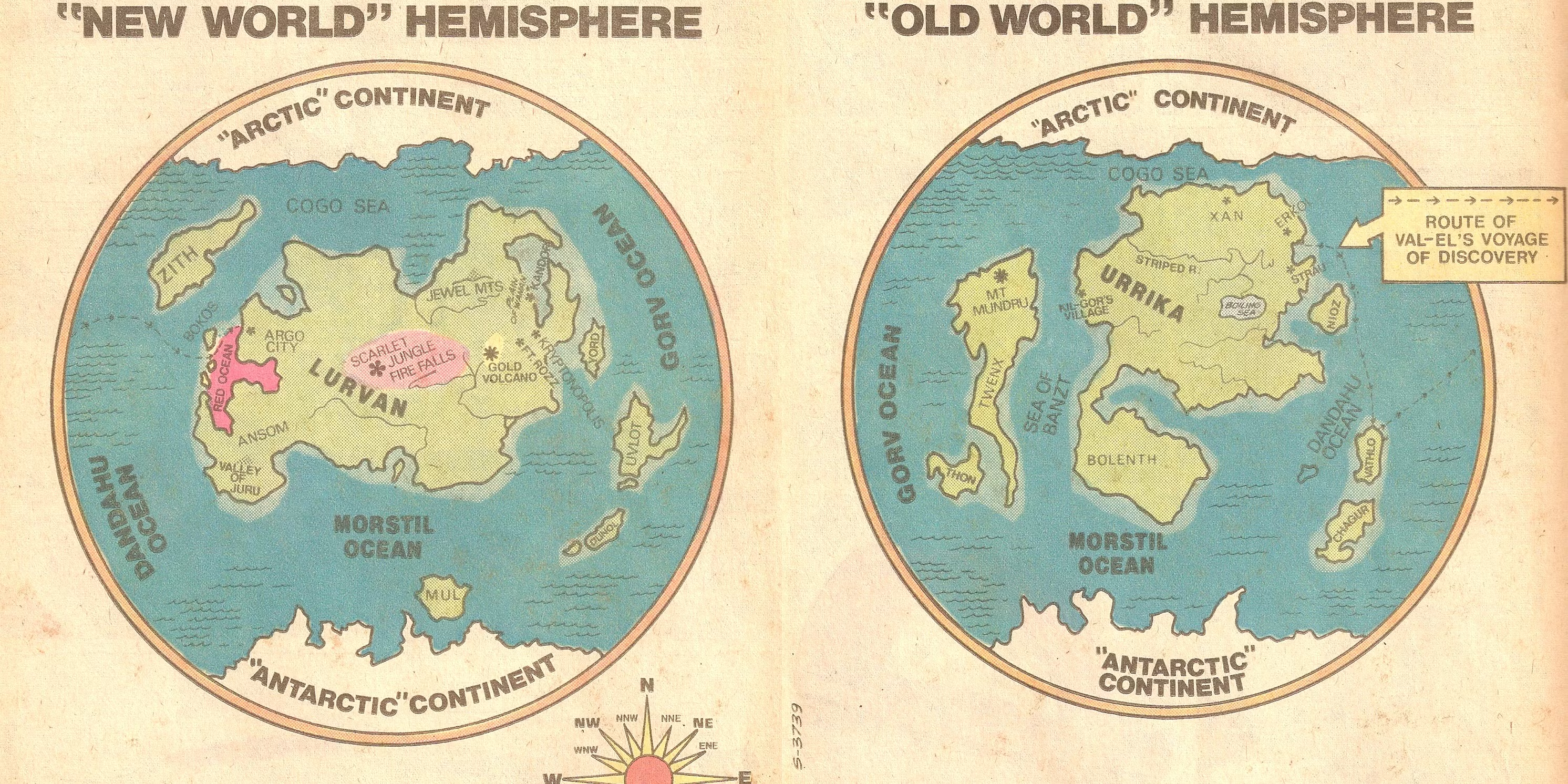
All five branches of the Kryptonian language family trace back to a common ancestor — *proto-Urrikan — originating on the Urrikan continent, Krypton’s cradle of civilization. Urrikan itself, never having undergone the pressures of oceanic migration or prolonged isolation, remained the most stable branch and the largest by population at the time of the Federation’s formation. Notable sub-branches include Bolian, Nionian, Xantian, and Modern Urrikan.
The earliest documented divergence came with outward oceanic migrations from Urrika: westward to the islands of Twenx, and eastward to the islands of Vathlo, producing the Twenx and Vath branches respectively. Vath subsequently subdivided further through further southward oceanic migration, yielding Middle Vath and Early Chaguran as distinct lineages leading to modern versions of both. On the islands of Twenx and Thon, what began as a register distinction — High Twenx and Low Twenx — eventually hardened into three separate branches: Twenx proper (descended from High Twenx), Wenz (from Low Twenx), and Thonian.
Another pivotal event in Kryptonian linguistic history was the “Voyage of Discovery” undertaken by Val-El — an expedition eastward from the Urrikan continent to the previously unknown continent of Lurvan, broadly analogous in its consequences to Columbus’ voyages on Earth. The initial period of rapid expansion from Urrika to Lurvan was followed by a long era of relative isolation, which produced two of the family’s most significant branches: Lurvanish, developing across western Lurvan, and Kandorian, spreading across the eastern half of the continent.
Lurvanish maintained broad mutual intelligibility across its regional dialects throughout its history — more a dialect continuum than a fragmented branch — with the exception of the island of Zith, situated off Lurvan’s northwest coast, developing its own distinct language, Zithian.
Kandorian showed similar regional variation on the continent, with several notable sub-branches presenting across the three main islands off Lurvan’s eastern coast: Yordian (near to Eastern Lurvan’s capital city of Kandor), Uvan, and Dunan. Of these island varieties, Yordian presents a linguistically interesting case of asymmetric intelligibility: Yordian speakers follow Kandorian readily, while Kandorian speakers find Yordian largely opaque — comparable to the documented relationship between certain Scandinavian languages, where proximity of exposure creates one-directional comprehension.
One notable outlier deserves mention. The continent of Mul, located in the far south near the polar region, remained uninhabited well into Krypton’s industrial age. When it was eventually settled, the colonists came from one of the very few regions where people were already accustomed to icy climates: Xan in the far north of the Urrikan continent, nearly the opposite point on the globe. As a result, Mul islanders were speaking Xantian all the way up to the point of the Modern Kryptonian transition.
Gender, Language, and Society
Modern Kryptonian employs natural gender — a system for marking the biological sex of living and/or sapient entities, rather than a grammatical category imposed across vocabulary. The mechanism is highly regularized, and by nature, the number of words employing the gendering mechanism is very limited. The neutral form is always the default, with shifts to masculine or feminine occurring for disambiguation, in intimate or close-family speech, or — perhaps counter-intuitively — in insulting speech (discussed below).
The Origins of Kryptonian Gender Morphology
Historically, the Urrikan, Vath, and Twenx branches retained gender morphology akin to Earth’s Romance languages with masculine, feminine, and neuter forms. On the flip side, the Lurvanish and Kandorian branches (with the notable exception of Zithian) lost their morphological gender during the isolation period. The Kandorian languages in particular shifted to a more analytic/periphrastic strategy, even around basic vocabulary, e.g., “male person and female person” rather than “man and woman.”
Val-Zho’s gender system represents an elegant synthesis of these two approaches into a single unified system with hallmarks of both. He took the efficiency of synthetic gender morphology and fused it with the efficiency of analytic usage resulting in something more efficient than either (very Kryptonian of him). The fact that Kryptonians on either side of this morphological divide found Val-Zho’s language familiar and intuitive is no small accomplishment.
Politeness Registers
Unless absolutely necessary for disambiguation, Kryptonian speech remains gender-neutral in the vast majority of situations. Gendered language can indicate intimacy between close relatives or spouses/lovers, but even then it is typically used sparingly. To “bring up” someone’s gender unnecessarily is considered rude, and often insulting. A decent analogy for us would be to imagine someone introducing their co-workers as “my black co-worker, John, my Asian co-worker, Jane, and my white co-worker, Steve.” The inclusion of race here should register as jarringly irrelevant at best the same way unnecessary gendering would to a Kryptonian.
In Kryptonian, gender is marked through vowel substitution, but one gender neuter vowel in particular, /y/, strongly resists gendering. Words carrying this vowel — words for monarch, elected leader, friend, spouse, several family terms, and others — reveal a strikingly egalitarian society. These are terms that almost always apply to positions of esteem in the social heirarchy, in particular leaders and kin. What is noteworthy in contrast to the majority of human languages is that deferential/polite speech is observed uniformly across all age ranges, without the young-to-old deference often encountered.
One historical document preserves a vivid illustration. A regional governor came before a queen to issue grievances, addressing her throughout with the gender-neutral /bythgr/ (monarch). When his argument shifted to direct criticism of her decisions, the document records that he stopped pacing, stood, looked directly at her, and began using /bethgr/ (the feminine form, queen). To those in attendance, the governor was being incredibly arrogant, condescending, and dismissive, conveying something like, “Because you are only a woman, I won’t hold you to the same standards I would a man.” After a stunned silence, he was immediately arrested and summarily executed.
The /y/ vowel is used in one notable, and clever, place that undoubtedly lives at the center of Val-Zho’s project ambitions. Every pronoun in Kryptonian is pluralized just like regular nouns save for one — the first-person plural pronoun for sapient beings: “we” — which Val-Zho separated out and placed in this strong-neuter respect category. The “we” in Kryptonian stands apart and is as broadly inclusive as the language allows — mirroring the exact goal of the Federation itself in one of the most common words in a language, and inescapable in the very name of the planet.
The Military Register
When it comes to the strong-neuter /y/ vowel, there are two notable exceptions worthy of mention. Military rank words, e.g., general, commander, lieutenant, etc., which would be expected to follow the established pattern and carry the strong-neuter form instead use standard gendering. Furthermore, military usage of language tends to be brazenly gendered in all but formal situations. The evidence points to three complimentary reasons for this unusual departure from the normal register.
First, in combat contexts, biological sex carries genuine practical relevance — physical capabilities and equipment coordination/sizing create legitimate operational contexts for sex-specification. Training soldiers to convey this information as a default speech pattern is a very real, very practical application that can save time and confusion in high-stress combat situations.
Secondly, military culture fosters bonds of extraordinary intimacy. Placing your life in the hands of your comrades requires enormous trust. For Kryptonians, it’s not only training, adversity, and hardship that builds these bonds, but the language itself with intimate speech drilled into cadets from day one.
Finally, because this register is considered brazen and rude outside of the military guild, it fosters a certain perception of “toughness” both amongst the populace and within the military itself. It fosters, on some small level, an attitude and perception toward soldiers that benefits their function in Kryptonian society.
Possessive Marking and Historical Drift
Alienable possession in Modern Kryptonian is marked through possessive pronouns formed by fusing a pronoun with the definite article. These forms vowel-harmonize with the noun they modify — so the possessive pronoun simultaneously encodes the possessor’s identity, the possessor’s gender, and the plurality of the thing possessed. For example: /tiv chahs/ (the table) → /tov chahso/ (the tables) → /zhehdiv chahs/ (their table) → /zhodov chahso/ (his tables).
The definiteness built into possession may seem unusual, but it reflects a cross-linguistically attested logic: possession implies uniqueness of reference. “My table” is not just any table — it is the table that is mine. The definite article encodes “you know which one I mean,” and possession is one of the strongest grounds for that shared reference.
The planet’s name, discussed above, preserves evidence of a simpler earlier possessive system in which possession was marked by bare pronoun preceding noun. The name is literally /kryp/ (we) /tahn/ (land) → “our land” — no fusion, no vowel harmony. The current system likely evolved from a transparent intermediate stage along the lines of /rraop tov chahso/ (“you the tables”) gradually fusing into the unified possessive pronoun forms seen today. The possessive system is one of the few areas of genuine documented drift in an otherwise remarkably stable language.
Postpositions and Logographs
Modern Kryptonian has an unusually large and semantically precise postpositional inventory, organized into subcategories for spatial, temporal, conceptual, and other relational meanings — often with distinct forms where most human languages would rely on linguistic ambiguity/flexibility. For example, English “at” can have various definitions depending on context: location (I was at my house), time (We met at three o’clock), target (I looked at my watch), and so on.
Given that postpositions are closed-class and grammatically load-bearing, their absence from the logographic set (discussed earlier) requires explanation. Historical evidence suggests that postposition logograms may have existed in the original designed language and were lost through disuse. The most likely explanation for their disappearance boils down to volume: an inventory this large and granular resists the rote memorization that makes an otherwise small logographic set practical.
As evidence, it is suspected that the logograph used in genitive construction (µ) may have begun life as a postpositional marker. The genitive system is notably complex, with four distinct forms: inalienable possession, two alienable forms (possessor-first versus possessed-first), and familial possession. The survival of this single logogram is almost certainly a function of visual disambiguation. The inalienable marker is the single letter i /i/ while the alienable possessed-first marker, im /im/, adds but a single phoneme. This particle, /im/, is phonetically identical to the closely related postposition for topic (I talked about him) which has been found written using the logograph, albeit rarely.
Critics counter this theory with an appeal to Kryptonian sensibilities and efficient nature which we have already seen as a strong driving force in Kryptonian usage. It should go without saying that a finite set of logographs for such high-frequency words, even if relatively large, would decrease space while increasing visual scan efficiency. The complete absence of such a set, they argue, is sociologic evidence that a logographic set never existed in the first place. The examples of postposition /im/ as logogram may in fact point in the opposite direction representing, perhaps, potential attempts to introduce logographs into the postpositional space.
Honorific Markers
The logographic honorific system reflects the centrality of House relationships directly. Five honorifics exist: one generic form for general social contexts, and four that encode specific possessive relationships to the speaker or community. These honorifics attach not only to names but to common person-words and pronouns — “he,” “she,” “I,” “you,” “son,” “father,” and so on all take honorific marking in appropriate contexts.
Using the word for “son” (/unah/) as an illustration:
- /unah,te/ — my son
- /unah,kah/ — our son
- /unah,ni/ — your son
- /unah,cheh/ — their son
In a House-organized society, the relationship between a person and their House — who claims them, who they belong to, who is responsible for them — is foundational identity. The honorific system makes those relationships visible in every sentence.
Family Vocabulary and Patrilineal Asymmetry
The structure of Kryptonian family vocabulary encodes the House system’s priorities without ambiguity. The paternal side carries rich, precise, highly differentiated vocabulary: distinct words for both paternal grandfather and grandmother, and distinct terms for paternal aunt and uncle and great aunt and uncle by blood (separate from paternal aunt and uncle by marriage). In contrast, the maternal side is collapsed into broad, undifferentiated categories: a single gendered word maternal grandparents and a single gendered word covering all maternal siblings, cousins, and extended family.
One need not read a single historical document to understand which lineage counts in Kryptonian society. The vocabulary encodes the answer on every page.
Legacy Languages as Aesthetic Registers
The adoption of Modern Kryptonian was effectively total. By the mature period of the Federation, regional languages had disappeared from everyday use entirely — there is no evidence of native speakers outside academic contexts. Modern Kryptonian was the sole living vernacular of the planet.
However, the legacy languages (outlined above) did not simply die. They were preserved, and eventually transformed into something without clear human parallel: aesthetic registers, chosen by writers the way a designer chooses a typeface.
Early in the corpus, a faint geographical signal is detectable — writers from regions historically associated with a given language show slightly elevated usage of that language in creative works. This signal disappears quickly. What replaces it is a mature system of language-as-aesthetic-choice, where the selection of a language communicates something about the nature and emotional register of the work. Kandorian for virtue poetry. Vath for scientific lyricism. Lurvanish for epics and chronicles. Each language carries a semantic halo built up from centuries of association — not assigned by committee, but accumulated through the weight of canonical works written in it.
This system only functions if readers can access those languages from the inside — not merely in translation, but experientially. Translation delivers content; it cannot deliver register. A Vath science poem read in Kryptonian translation loses the very quality that makes it a Vath science poem. The aesthetic language system is enabled, driven, and reliant on a technology that emerged early in the planetary Federation that circumvented tedious language acquisition and was capable of delivering a depth of linguistic competence in hours or days that months or even years of traditional study may never produce.
The historical sequence — unification, followed by a notable drop-off in non-Kryptonian records, followed by an explosion in aesthetic-language art forms — suggests the technology may have developed, at least in part, as an attempt at language preservation. The near obliteration of the natural languages was undoubtedly an unexpected and unwelcome consequence of unification. In this area, at least, the project proved to be too successful.
The effect of this new technology, though, ended up being somewhat paradoxical in its outcome. It turned the natural languages into zombies, no longer dying, but no longer truly living either. Instead, they were transformed into a calcified form based solely on aesthetics. The connection to the past — histories, archaeology, poetry — were all preserved, but a fundamental diversity of thought was lost in the process, no doubt a key contributor to Krypton’s eventual societal stagnation.